Hi-AUDiO FLO Participant Survey — Analysis Summary
At a glance. Among the nine participants from the Female Laptop Orchestra (FLO), the headline rating — whether the platform meets the necessary standards as a professional audio recording application (Q16) — is centred on the scale midpoint: mean 4.00 of 7 (3.88 excluding P09), with individual ratings from 1 to 6. Clarity and low mental effort were the highest-rated items (5.33 each) and usefulness for recording music the lowest (3.56). In the open answers, the collaborative multi-track setting (5 of 6 Q21 answers) and ease of use (4 of 6) were the strengths most often named; waiting for tracks to process (3 of 6 substantive Q22 answers) and missing editing tools (2 of 6) were the most frequent challenges. Where the survey speaks to the practice-based evaluation memo (Brown, 2026), it agrees with it — fully on some points, partly on others — and contradicts none of it; but it gives no independent support to three of the four development priorities in memo §8 (§7.1). All results are descriptive and limited to this small expert cohort (§8).
Contents #
- 1. Scope and Analytic Approach
- 2. Sample Description (Q1–Q15)
- 3. Q16 — Headline Result
- 4. Q16–Q20 — Quantitative Results
- 5. P09-Excluded Sensitivity Analysis (n = 8)
- 6. Q21–Q23 — Thematic Findings
- 7. Triangulation with the Practice-Based Memo
- 7.1 Memo findings the survey does not corroborate
- 8. Limitations and Researcher Positionality
- 9. Conclusions
- References
- Appendix: Survey questions
1. Scope and Analytic Approach #
This document analyses the nine responses to the Hi-AUDiO FLO participant survey and triangulates them against §4–§8 of the practice-based evaluation memo (Brown, 2026). Q1–Q20 are summarised descriptively (frequencies, means, medians, ranges). The four free-text list items are handled differently from the fixed-option questions — entries in Q3 and Q4 were categorised by hand and then counted, while Q6 and Q7 are summarised in prose without counts. The open questions Q21–Q23 are analysed through hybrid deductive/inductive thematic coding — answers are grouped under topics taken from the memo (deductive) and under new topics raised by respondents (inductive); findings are then compared against the memo to identify confirmation, nuance, contradiction, or new findings. The full wording of every question is given in the Appendix.
The analysis is exploratory and descriptive. No inferential statistics (confidence intervals, significance tests, regressions) are computed or implied, consistent with the small, non-random, single-organisation expert cohort (n = 9 FLO performers). All findings below are scoped to FLO participants in this study and should not be generalised beyond it.
Each respondent has a participant identifier (PID), assigned in submission order from P01 (20 May 2026) to P09 (3 July 2026). Each submission date is unique and appears both in the CSV and in that respondent's PDF in docs/individual_participant_responses/, whose Submission N ordinal matches the participant number. The per-respondent attributions in §5 and §6 rest on this numbering.
One respondent, P09, is Nela Brown: a co-designer of the questionnaire, the author of the practice-based memo and a co-author of this analysis. This is treated throughout as a disclosed methodological condition: her response is retained in all primary (n = 9) results, and headline quantitative items are additionally reported with her excluded (n = 8). Full treatment, including the other author's role, is in §8 below.
Provenance of the rating items. Q18 and Q19 reproduce published technology-acceptance scales: Q18 is the four-item Perceived Ease of Use scale and Q19 the three-item Perceived Enjoyment scale, both as worded in Venkatesh (2000, Appendix 1) — adapted there from Davis (1989) and Davis, Bagozzi and Warshaw (1992) respectively — with the verb tense changed from present to past ("I find…" → "I found…") and the platform named in place of "the system"; Q18_2 also drops one word ("a lot of my mental effort" → "a lot of mental effort"). Q20_2 is Davis's (1989) perceived-usefulness item with the domain changed from "in my job" to "for recording music." Q20_1 and Q20_3 are attitude and behavioural-intention items in the technology-acceptance tradition, but their direct wording source has not been established and none is claimed here. Q20_4, and the single items Q16 and Q17, were written for this study.
Two consequences follow. The instrument as assembled is not a standardised questionnaire and was not re-validated for this population: items were recombined across sources and n = 9 cannot establish reliability. Separately, the source scales were written to be answered about a system in current use, whereas this survey was answered retrospectively, months after the evaluation period (§8). Results are therefore descriptive throughout — not compared against published norms for any source scale, and block means are not treated as validated subscale scores.
2. Sample Description (Q1–Q15) #
Nine FLO performers completed the survey. All percentages below use n = 9 as the denominator unless otherwise noted.
Musical roles (Q1, select all that apply — 29 selections across 9 respondents, ≈3.2 roles per person on average): Performer (instrumentalist/vocalist) 9/9 (100%), Improviser 6/9 (67%), Composer or arranger 4/9 (44%), Sound engineer 3/9 (33%), Educator 3/9 (33%), Producer 2/9 (22%), Ensemble Leader 1/9 (11%), Audio Researcher 1/9 (11%). The cohort is a multi-role expert group rather than single-specialism performers.
Prior browser-based recording tool experience (Q2): 5/9 (56%) had prior experience, 4/9 (44%) did not. Tools named elsewhere in the survey (Q3/Q4) include SoundJack, Sonobus, and BandLab.
Similar platforms and digital audio workstations (DAWs) — Q3 and Q4: Sonobus was the most commonly named comparable platform (Q3: 5/9 respondents), with SoundJack and BandLab tied for second (2/9 each). Software normally used (Q4) was broad and professional-grade: the Ableton family (Ableton/Ableton Live/Ableton Lite) named by 4/9 respondents, Bitwig by 3/9, and Playsound.space — a web-based platform rather than a DAW — also by 3/9, with single mentions of Reaper, Cubase, Digital Performer, Adobe Audition, Vital, and routing/utility tools (Loopback, Audio Hijack). Both are free-text list widgets, so a few entries cross the two categories (P02 listed Bitwig, a DAW, under Q3; P06 listed Sonobus, a network-collaboration tool, under Q4); the counts above follow each tool's actual category rather than the field it was typed into, and no reported figure is affected.
External audio interface use (Q5): "Yes, always" 4/9 (44%), "Yes, sometimes" 3/9 (33%), "No — I use built-in audio (laptop or phone microphone)" 2/9 (22%). 78% used an external interface at least some of the time.
Instruments and proficiency (Q6 — descriptive): wide instrumentation across the cohort (keyboard, bass guitar, saxophone, guitar, piano, voice, cello, synthesizers, flute, bagpipes, percussion, and others), with proficiency self-ratings spanning Beginner to Expert/Professional. Most respondents reported Intermediate-to-Expert level on at least one instrument.
What was recorded for the Radiophrenia 2026 Jam (Q7 — descriptive): voice/vocals, percussion, kazoo, cello, guitar, piano, synth, soundscape, and Supercollider-generated material; one respondent (P09) contributed the session's opening binaural field-recording track — a pre-existing recording (its filename is dated 2025-11-18) that also served as the composition's guide track, rather than material recorded during the evaluation period.
Recording/upload method (Q8, select all that apply): direct recording via audio interface + microphone 4/9 (44%); upload after recording in an external sound recorder 2/9 (22%); upload after recording in a DAW 2/9 (22%); routed live from a DAW 2/9 (22%).
Latency measurement (Q9): "Not applicable — I only uploaded files" 3/9 (33%); "Yes, every time I recorded something" 3/9 (33%); "Yes, but only once for the whole session" 2/9 (22%); "No" 1/9 (11%, P01).
Q10 (conditional on Q9 = "No"): denominator is n = 1 (P01, the sole respondent who answered literal "No"; the three "Not applicable" respondents were correctly not shown this question by the form's conditional logic). P01's stated reason: "I didn't think it was necessary".
Session structure (Q11): single session 5/9 (56%); across several sessions same day 2/9 (22%); across different days 2/9 (22%).
Time spent (Q12): more than 60 minutes 4/9 (44%); 30–40 minutes 3/9 (33%); 20–30 minutes 1/9 (11%); less than 20 minutes 1/9 (11%). Most participants (7/9, 78%) spent 30 minutes or more.
Operating system (Q13): macOS 8/9 (89%), Windows 1/9 (11%). Browser (Q14): Firefox 5/9 (56%), Chromium/Chrome 3/9 (33%), Safari 1/9 (11%).
Headphones (Q15): Wired 7/9 (78%), None 2/9 (22%). No respondent reported wireless headphones.
Sample character: a small, multi-disciplinary, technically experienced cohort, heavily skewed toward macOS (89%) and, less strongly, Firefox (56%). Engagement varied: just over half (5/9) worked in a single session and most (7/9) spent 30 minutes or more, but only three respondents (P01, P02, P03) met both conditions — so a "substantial single sitting" describes some, not most, of the sample, and the two figures should not be read as a joint pattern. The operating system and browser skew is noted as a limitation in §8.
3. Q16 — Headline Result #
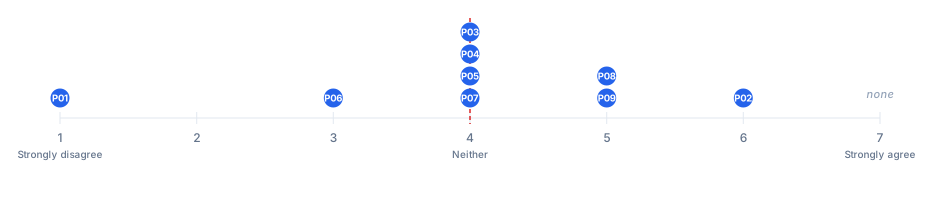
Q16 — whether the platform meets the necessary standards as a professional audio recording application — is the headline metric and is reported first. Its construct is professional standards specifically; artistic-intention support is a separate item (Q17, §4), and the two should not be merged into a single "professional/artistic" judgement.
| n | Mean | Median | Range | |
|---|---|---|---|---|
| Q16, full sample | 9 | 4.00 | 4.0 | 1–6 |
| Q16, P09 excluded | 8 | 3.88 | 4.0 | 1–6 |
Both figures sit almost exactly on the 7-point scale's midpoint (4.0 = "Neither disagree nor agree"), indicating a mixed, centred rather than clearly positive or negative view of the platform's suitability as a professional audio recording application among this cohort. The distribution shows this is a genuine spread rather than uniform neutrality: one respondent (P01) rated it 1 ("Strongly disagree"), one rated it 3, four rated it 4, two rated it 5 and one rated it 6. No respondent rated it 2, and none selected the scale's top option, "Strongly agree" (7).
4. Q16–Q20 — Quantitative Results #
Q17 — Artistic intention support (supporting metric) #
| n | Mean | Median | Range | |
|---|---|---|---|---|
| Full sample | 9 | 4.22 | 4.0 | 2–7 |
| P09 excluded | 8 | 3.88 | 3.5 | 2–7 |
Q17 is also read alongside the open answers to Q21 and Q22. Read that way, the Q21 collaboration theme (contributing to and hearing a shared artistic project) plausibly supports a sense of artistic-intention support, while the Q22 editing-tools gap (§6) plausibly works against it. The survey does not ask respondents to explain their Q17 rating, so this is a reading of the qualitative data rather than an established link.
Q18 — Pragmatic usability (Perceived Ease of Use; Venkatesh, 2000) #
| Item | Statement | n=9 Mean | n=9 Median | n=9 Range |
|---|---|---|---|---|
| Q18_1 | Clear and understandable | 5.33 | 5.0 | 3–7 |
| Q18_2 | Did not require a lot of mental effort | 5.33 | 6.0 | 3–7 |
| Q18_3 | Easy to use | 4.89 | 5.0 | 2–7 |
| Q18_4 | Easy to get it to do what I wanted | 4.00 | 4.0 | 1–7 |
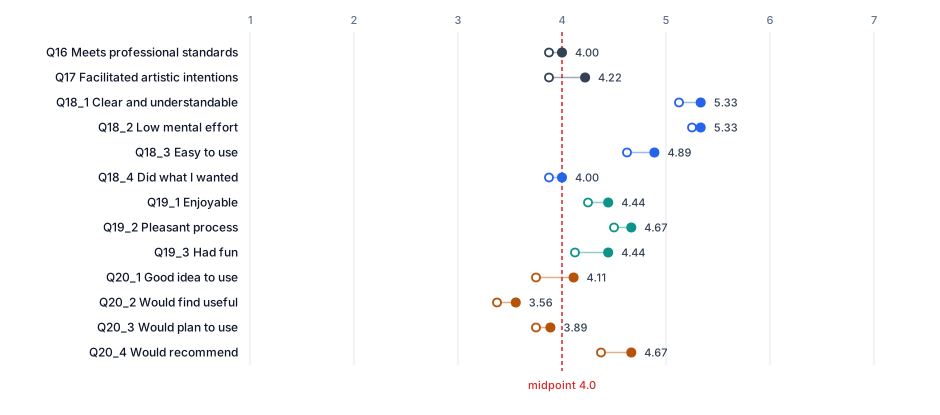
Q18_2 is worded so that a higher score indicates lower mental effort; it was therefore not reverse-coded. All four items sit at or above the midpoint, with the first-impression items (clarity, mental effort) rated more favourably than the goal-completion item (Q18_4), which sits exactly at the midpoint.
Q19 — Hedonic/experiential quality (Perceived Enjoyment; Venkatesh, 2000) #
| Item | Statement | n=9 Mean | n=9 Median | n=9 Range |
|---|---|---|---|---|
| Q19_1 | Enjoyable | 4.44 | 4.0 | 1–7 |
| Q19_2 | Process was pleasant | 4.67 | 4.0 | 2–7 |
| Q19_3 | Had fun | 4.44 | 4.0 | 2–7 |
All three items sit modestly above the midpoint.
Q20 — Future use intent and perceived usefulness #
| Item | Statement | n=9 Mean | n=9 Median | n=9 Range |
|---|---|---|---|---|
| Q20_1 | Good idea to use for recording music | 4.11 | 4.0 | 2–7 |
| Q20_2 | Would find it useful for recording music | 3.56 | 3.0 | 1–6 |
| Q20_3 | Would plan to use in a future project | 3.89 | 4.0 | 2–6 |
| Q20_4 | Would recommend to colleagues | 4.67 | 5.0 | 2–7 |
Q20_2 ("would find it useful for recording music") is the lowest-rated of all thirteen 7-point items (mean 3.56, median 3.0, both below midpoint) — lower even than Q16. Q18_1 and Q18_2 (clarity, low mental effort) are the highest, at 5.33 each. Descriptively, then, mean ratings indicate the platform was found pleasant and easy to use during the evaluation, and rated lower on average for practical usefulness in future recording work — though not uniformly so at the item level. §9 weighs that reading against the qualitative and triangulation findings.
5. P09-Excluded Sensitivity Analysis (n = 8) #
The table compares Q16–Q20 results with and without P09.
| Item | Mean (n=9) | Mean (n=8) | Change in mean (Δ) | Median (n=9) | Median (n=8) |
|---|---|---|---|---|---|
| Q16 | 4.00 | 3.88 | −0.12 | 4.0 | 4.0 |
| Q17 | 4.22 | 3.88 | −0.35 | 4.0 | 3.5 |
| Q18_1 | 5.33 | 5.13 | −0.21 | 5.0 | 5.0 |
| Q18_2 | 5.33 | 5.25 | −0.08 | 6.0 | 5.5 |
| Q18_3 | 4.89 | 4.63 | −0.26 | 5.0 | 4.5 |
| Q18_4 | 4.00 | 3.88 | −0.12 | 4.0 | 3.5 |
| Q19_1 | 4.44 | 4.25 | −0.19 | 4.0 | 4.0 |
| Q19_2 | 4.67 | 4.50 | −0.17 | 4.0 | 4.0 |
| Q19_3 | 4.44 | 4.13 | −0.32 | 4.0 | 4.0 |
| Q20_1 | 4.11 | 3.75 | −0.36 | 4.0 | 3.5 |
| Q20_2 | 3.56 | 3.38 | −0.18 | 3.0 | 3.0 |
| Q20_3 | 3.89 | 3.75 | −0.14 | 4.0 | 3.5 |
| Q20_4 | 4.67 | 4.38 | −0.29 | 5.0 | 4.5 |
Change in mean (Δ) is the mean for n = 8 minus the mean for n = 9, calculated before rounding. Values are rounded to two decimal places, with ties rounded toward positive infinity.
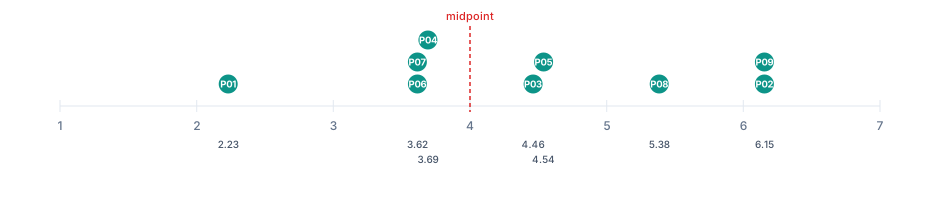
P09 rated all thirteen items between 5 and 7 (mean 6.15), so excluding her lowers every mean by 0.08 to 0.36 points. Four items (Q16, Q17, Q18_4, Q20_1) move from at-or-just-above the 4.0 midpoint to just below it once she is excluded; no item reverses by more than half a scale point. Both figures are reported, but the divergence does not change the interpretation — the sample was already centred on the midpoint with P09 included, and remains so without her.
This sensitivity check excludes P09 because she co-designed the survey and wrote the evaluation memo. P02 had the same mean (6.15) and minimum rating (5).
6. Q21–Q23 — Thematic Findings #
Response rates were verified against the CSV before coding: Q21: 6/9 answered, Q22: 7/9, Q23: 5/9. Two of the five Q23 responses (P02: "no, sorry! just musicians!"; P01: "No") decline to suggest a use case rather than offering one, so only 3/9 gave a substantive Q23 answer. Q21–Q23 are optional on the form, so blanks are expected item nonresponse, not an export defect or data loss.
Themes are labelled recurring (≥2 respondents) or isolated observation (1 respondent). One answer can count toward more than one theme, so a question's theme counts can add up to more than its number of answers. Excerpts are attributed by PID only and are quoted exactly as submitted, including respondents' own spelling, list punctuation and spacing.
Q21 — Most useful/effective aspects (deductive frame: memo §4) #
Theme: Collaboration and multi-track listening — recurring (5/6 respondents: P08, P04, P03, P02, P01)
P08: "Ability to collaborate"
P03: "Intuitive understanding, and possibility to listen to the other tracks easily"
Partially confirms memo §4.1 (Accessibility), which frames distributed collaboration as a strength: this is the most frequent Q21 theme, but browser-based access itself — §4.1's actual subject — is named by only one respondent, so the accessibility framing is supported only indirectly. The code bundles explicit mentions of collaborating with others (4/6: P08, P04, P02, P01) with P03's mention of listening easily to other tracks, which implies the multi-track collaborative context without naming collaboration — so the dominant benefit is best stated as the collaborative multi-track setting broadly, not "collaboration" as a term respondents themselves converged on. This does not independently confirm §4.4 (Track Annotation): no Q21 answer mentions notes, annotations, or track metadata.
Theme: Ease of use / intuitive interface — recurring (4/6: P09, P08, P03, P02)
P09: "The interface was very easy to understand. I did not need to read a manual or watch any videos..."
P02: "It was so easy to use..."
Confirms memo §4.2 (Ease of Use) directly, including a near-verbatim echo of the memo's own quoted phrase ("simple and easy to use").
Isolated observation: Streaming quality (P02 only)
P02: "...the quality of the streaming / collaboration"
The only Q21 answer to mention quality of any kind. It does not say whether "streaming" means playback of the shared tracks or the collaborative exchange itself, so it is reported without further interpretation.
Browser-based accessibility was mentioned only implicitly (P04: "...on the browser", bundled with collaboration) — present in the data but not independently prominent, in contrast to its centrality in the memo.
Q22 — Challenges (deductive frame: memo §5) #
Seven respondents answered. One (P02) reported simply "No challenges"; the remaining six (P09, P08, P06, P04, P03, P01) gave substantive answers, and the fractions below are out of those six. P01 also opened with "No challanges, but..." (their spelling) before giving the most critical assessment of professional fit in the dataset — they appear to reserve "challenges" for something narrower than the missing professional features they then describe.
Theme: Absence of editing/audio-manipulation tools — recurring (2/6: P08, P01)
P08: "...i would have used it for recording if there was a way to cut, copy, and paste sections of the recording. It would also have been useful to manage the volume enveloppe..."
P01: "No challanges, but it's too basic to use professionally, as we cant choose the record point, can't crop or edit the sound files or do basic sound volume enveloping, so it has no advantage comparing to other software"
Confirms memo §5.4 (Editing and Audio Manipulation) closely, down to the specific missing features named (cut/copy/paste, volume envelope). P01's broader framing ("too basic to use professionally") also echoes §7's own assessment of the platform as not yet suited to end-to-end professional workflows — consistent with P01 having given the lowest Q16 (1) and Q17 (2) scores in the sample.
Theme: Post-recording processing/sync wait time — recurring (3/6: P09, P06, P04)
P09: "...it took a long time for the track to be 'rendered', so I had to keep Firefox open until that was completed..."
P06: "- waiting time for recorded tracks to be synced with the serwer"
Confirms memo §5.6 (Signal Flow and Rendering Stability), which itself opens by citing "long rendering times." The survey's mentions concern wait time specifically, rather than the clipping/artefact example §5.6 elaborates via Loopback routing — a modest difference in emphasis, offered cautiously at this n. This is distinct from Q9, which asks only whether respondents ran the platform's built-in latency measurement before recording; no respondent reported that measurement as a problem. Note also that the three respondents do not describe the same mechanism: P06 names server synchronisation ("synced with the serwer"), while P09 says "rendered" and P04 says "processing" without locating the delay — so a shared experience of waiting is well supported, a shared server-side mechanism is not.
Isolated observation: Live input-level control (P06 only)
P06: "- no options to manipulate audio input levels or other audio parameters on the fly when recording"
Confirms memo §5.3 (Recording Workflow Limitations), which notes the platform "lacked visible input gain control." Distinct from the editing theme above: this concerns adjusting levels live, during recording, not shaping already-recorded material.
Isolated observation: Visual feedback / interface clarity (P09 only)
P09: "...did not provide very clear feedback when buttons were pressed (i.e. buttons did not change colour), so it was difficult to see if something was happening or not (visually)."
Confirms memo §5.1 directly — but from a single respondent, and specifically the memo's own author. This agreement is therefore expected and is not independent corroboration: it is the same authorial voice. Her fuller answer also names transport-bar and Mute/Solo button confusion.
The same answer also lands on memo §5.2: "hovering over the 'Headphone' icon shows text 'select cursor' which is confusing as it is very different to DAW" matches §5.2's note that "the function of the headphones icon (Select Cursor) was not immediately clear to some participants." This qualifies rather than contradicts §4.3 (Interface Discoverability), which cites hover-over labels as an orientation aid: §4.3's example is the Stop control, whose label is self-explanatory, whereas the Headphone icon's label names a different function than the icon depicts — the same mechanism helping in one case and confusing in another, not an internal inconsistency in the memo. Again, this is not independent corroboration.
Isolated observation, mechanism unclear: possible noise/audio issue during a second take (P03 only)
P03: "Noise were introduced during a second recording session, while also including a sound source from browser. I had to delete it."
The respondent does not specify how this happened, so it is reported as a tentative single-respondent observation rather than a confirmed "signal bleed" or "capture" mechanism. It sits adjacent to, but does not clearly match, memo §5.6's routing/artefact examples — no routing tool or clipping is named.
No respondent raised file-format compatibility, browser/network compatibility, or the absence of keyboard shortcuts as a Q22 challenge — all three despite the first two belonging to the deductive frame. File-format friction (§5.8) and missing keyboard shortcuts (§5.2) have their own memo subsections, so their absence here is reportable (see §7.1). Browser behaviour is a different case: the memo has no §5 subsection for it and treats browser-based access as a strength (§4.1), but Appendix B does record browser-specific friction — a Firefox microphone-permission icon that was sometimes hidden (Fig B2), and a browser refresh being needed before Loopback appeared as an input device (Fig B3). Neither was raised by any respondent. Transport-related concerns do appear (P09's transport-bar/Mute/Solo comments; P01's inability to choose the record point) but fall within the visual-feedback and editing themes above rather than forming a separate recurring theme.
Q23 — Other use cases (deductive/inductive, per memo §6/§7) #
Three respondents gave substantive suggestions. Peer ensemble collaboration is a recurring theme at the broad level (2/3: P04, P06), though the two proposed applications differ — cross-timezone collaboration versus lighter-weight preliminary sessions — so each is presented separately below. The code is defined narrowly, as peer ensemble work: P09's remote-education scenario also involves two parties exchanging recordings, but the relationship there is asymmetric and pedagogical rather than co-creative, so it is coded as its own theme. Under a broader definition the count would be 3/3; the narrow reading is used because memo §4.1's collaboration framing concerns distributed performers co-producing a single work.
Isolated, inductive — new finding, proposed as an extension rather than a current capability: Remote music education (P09 only)
P09: "Hi-Audio platform would be very useful in remote music education. ...a teacher can record introductory videos... They can then record a simple scale, upload sheet music for the scale, and the child can play along with this recording to practice. When they think they have practised enough, they can record a track. The teacher will review it, give them feedback... I understand this is a completely different view of how the platform could be used, and would involve changes to the platform, but it is worth thinking about." (condensed from a longer response describing a full remote-teaching scenario for a hypothetical student without access to a nearby music school; her closing sentence is quoted in full)
Not addressed anywhere in memo §4–§8, and the only substantively new use case in the Q23 set. It is reported here with the qualification P09 herself attached to it: the scenario turns on capabilities the evaluated version did not have — uploading video lessons and sheet music, and reviewing past sessions — and she states plainly that it "would involve changes to the platform." It is therefore a proposed direction for development, not evidence that the platform as evaluated fits an educational context. This distinguishes it from the two Q23 suggestions below, which describe uses the platform already supports.
Isolated — nuances §7: Preliminary jam/collaboration sessions (P06 only)
P06: "- preliminary jam/collaboration sessions"
§7 concludes the platform is not yet fit for end-to-end professional production. P06's suggestion is consistent with that conclusion rather than contradicting it: it fits the platform to a lighter-weight preliminary/rehearsal use — a positive framing of the same limitation.
Isolated — confirms/extends §4.1: Distributed, cross-timezone collaboration (P04 only)
P04: "Distributed collaborations across different locations and time zones"
Extends the existing accessibility/collaboration strength prospectively rather than introducing a new one. With P06's suggestion above, this forms the 2/3 collaborative-use theme noted at the start of this section.
Counterweight. Two of the five who answered Q23 named no further context: P01 answered "No", and P02 "no, sorry! just musicians!" — the latter an explicit claim that the platform's applicability does not extend beyond musicians, which bears on §7's platform-fit assessment. These are responses, not silence, and are reported as data: 2 of the 5 who answered Q23 named no further use case. Neither is raised to a coded theme, because "declined to name one" is not a substantive shared idea; P02's scope limitation is content, and is recorded as such in the sentence above.
7. Triangulation with the Practice-Based Memo #
| Memo section | Survey evidence | Relationship |
|---|---|---|
| §4.1 Accessibility | Q21: collaboration/multi-track theme (5/6); explicit collaboration mentions 4/6 | Partially confirms — browser-based access itself is named by only one respondent (P04), so the accessibility framing is confirmed indirectly. Does not confirm §4.4 Track Annotation: no respondent mentioned notes or annotations |
| §4.2 Ease of Use | Q21: ease-of-use theme (4/6); Q18_1/Q18_2 highest-rated items (5.33 each) | Confirms strongly, quantitatively and qualitatively |
| §5.1 Visual Feedback and Interface Clarity | Q22: P09's isolated comment | Confirms, but non-independent (same authorial voice as the memo) |
| §5.2 Transport Controls and Navigation | Q22: P09's Headphone-icon comment; P01's "cant choose the record point" | Confirms the icon-clarity point (non-independent); qualifies §4.3, whose hover-label example is the Stop control. §5.2's keyboard-shortcut and Fast Forward/Rewind points drew no mention |
| §5.3 Recording Workflow Limitations | Q22: P06's live input-level control observation | Confirms (isolated, single-respondent) |
| §5.4 Editing and Audio Manipulation | Q22: editing-absence theme (2/6); Q20_2 lowest-rated item (3.56) | Confirms. Plausibly consistent with the muted future-use results, though the survey does not ask why Q20_2 was rated low |
| §5.6 Signal Flow and Rendering Stability | Q22: processing/sync wait-time theme (3/6) | Confirms — §5.6 already names "long rendering times"; the wait-time emphasis is a modest nuance, not a new one |
| §5 (no clean subsection match) | Q22: P03's noise/audio observation | Tentative — mechanism unclear; adjacent to but not a clean match for §5.6 |
| §6 Design Implications | Q22/Q23 findings generally | Partially confirms. Three of the four priorities the survey speaks to are raised by respondents other than the memo's author — editing tools (2/6: P08, P01), input control (P06), and delays while tracks were processed or synchronised (3/6, two of them independent: P06, P04). Those respondents describe waiting, not unstable rendering. Visual feedback is raised only by P09, the memo's own author, so it is not independently corroborated (§7.1) |
| §7 Platform Fit | Q16 (4.00/3.88, centred on midpoint); Q17 (4.22/3.88); Q20 (mixed, Q20_2 lowest of all items) | Confirms §7's reading of the platform as "a lightweight multitrack recording environment rather than a fully featured creative production system" — centred results align with a qualified rather than unqualified fit |
| §7 / §8.2 (not addressed) | Q23: P09's remote-education suggestion | New finding, but a proposed extension: P09 states it "would involve changes to the platform," so it does not bear on the fit of the version evaluated |
Denominators differ by question and are not a common scale: Q21 fractions are out of the 6 respondents who answered Q21; Q22 fractions are out of the 6 substantive answers among the 7 who answered (P02's "No challenges" carries no content to code); Q23 fractions are out of the 3 substantive answers. See §6.
7.1 Memo findings the survey does not corroborate #
The table above has rows only where survey evidence exists. Read alone, that hides an equally reportable result: several memo findings — including three of the four development priorities memo §8 calls "the most critical areas for development" — drew no independent support from this survey. Denominators below are the six substantive Q22 answers, as in §6.
| Memo §8 critical area | Independent survey support |
|---|---|
| Improved visual feedback for active states | P09 only — and P09 authored the memo, so this is non-independent by the positionality rule applied throughout |
| Standard keyboard shortcuts | No mention in any Q22 answer |
| Uncompressed export formats (§5.8, .m4a friction) | No mention in any Q22 answer |
| Basic non-destructive editing tools | 2/6 (P08, P01) — the only one of the four with independent survey support |
Three further memo subsections drew no survey mention at all: §5.5 (accidental timeline shifts), §5.7 (pinch-to-zoom / gestural support), and §5.9 (track renaming). §4.4 (Track Annotation) is likewise unconfirmed — no Q21 answer mentions notes or annotations (see the §4.1 row above).
How to read this. Absence of mention in a small, optional free-text question is not evidence of absence: the memo drew on sustained observation across the whole evaluation period, which a single retrospective item cannot replicate, and the survey did not ask about these areas directly, did not measure export behaviour, and cannot show whether respondents reached the relevant workflow stage. The narrow claim is only that these issues were not raised spontaneously in the Q22 answers. (Note that memo §5.2 locates the keyboard-shortcut cost inside the platform — the missing Spacebar Play/Stop slowing recording sessions — not at the point of export.) This is a descriptive observation about where survey and memo evidence overlap, not a recommendation to reweight §8's priorities.
Narrative summary: where the survey speaks to a memo finding it agrees with it — fully on some points, partly on others, and on some only through the memo author's own answers — and no survey finding contradicts the memo; but it does not speak to all of them, as §7.1 sets out. The most frequently recurring Q22 concern is post-recording wait time (3/6), directly confirming §5.6; the editing/audio-manipulation gap (2/6) is mentioned less often but is where the survey's most critical respondent, P01, concentrated their comments. One clearly new observation emerges (P09's remote-education use case) alongside one tentative single-respondent observation whose mechanism the data does not establish (P03's noise/audio issue during a second take).
8. Limitations and Researcher Positionality #
- Sample size and scope. n = 9, a small, non-random, single-organisation expert cohort (FLO performers). Descriptive statistics only; findings are scoped to "FLO participants in this study" and should not be generalised to other users, platforms, or contexts.
- Platform/browser skew. 8/9 respondents used macOS and 5/9 used Firefox; only one data point exists for Windows and for Safari each. Findings may under-represent OS- or browser-specific issues.
- Partial response to open questions. Q21–Q23 were answered by 6/9, 7/9, and 5/9 respondents respectively (only 3/9 gave a substantive Q23 answer). Thematic findings in §6 reflect these smaller subsets, not the full n = 9.
- One coder for the open questions. Q21–Q23 were coded by a single coder; no second coder coded the answers independently, and no inter-coder agreement was measured. Where a coding decision is a judgement call — for example the scope of the collaboration codes in Q21 and Q23 (§6) — the alternative reading and its effect on the count are stated alongside it.
- Researcher positionality. Both authors co-designed the questionnaire. Nela Brown is also respondent P09, the author of the practice-based memo against which findings are triangulated, and a co-author of this analysis. José M. Gil Panal is the lead software engineer of the platform evaluated; he did not complete the questionnaire. Handling here: (a) she is retained in all primary n = 9 results; (b) Q16–Q20 are additionally reported at n = 8 excluding her (§5); (c) her Q22 comment on visual feedback is flagged as non-independent corroboration of her own memo's §5.1; (d) her Q23 education-use-case suggestion is flagged as sourced solely from her. As §5 shows, her ratings are high but not numerically unique (P02's mean and floor are identical) — the n = 8 figures are a transparency measure tied to her disclosed role, not an outlier correction.
- Instrument caveat. Q18 and Q19 reproduce Venkatesh's (2000) Perceived Ease of Use and Perceived Enjoyment scales, and Q20_2 is Davis's (1989) usefulness item; but the instrument as assembled recombined items across sources, changed their tense from present to past, and was never re-validated. Absolute scores are therefore read descriptively and are not compared to published norms (see §1 and References).
- Retrospective self-report, collected months after use. The evaluation period ended on 13 March 2026; responses were submitted between 20 May and 3 July 2026, a lag of 68 to 112 days. Several questions, Q22 in particular, ask respondents to recall specific interface behaviours — which icons were unclear, how long rendering took, whether a control responded as expected — and a gap of this length gives no reason to expect recall of that detail to be complete, so absence of a specific complaint may reflect imperfect memory rather than absence of the problem. The data cannot say how often it does. This reinforces the caution in §7.1. The intervals are measured from the common evaluation end date and the survey did not record when each respondent last used the platform, so an individual's actual gap may be longer; the lag also varies across the sample by 44 days, so respondents were not all recalling from the same distance.
- Single time point, within a communicating cohort. All data was collected in one wave, within a cohort that communicated informally (WhatsApp group, per memo §3) during the study — some convergence in language or emphasis between respondents may partly reflect shared discussion rather than fully independent impressions.
9. Conclusions #
Among FLO participants in this study, the platform's perceived suitability as a professional audio recording application (Q16) sits almost exactly at the 7-point scale's midpoint (mean 4.00, n = 9; 3.88 with P09 excluded), indicating a mixed rather than clearly positive or negative view. This is not uniform neutrality: ratings range from strongly critical (P01, "Strongly disagree") to clearly positive (P02 "Agree," P09 "Somewhat agree"), and no respondent selected the scale's top option on Q16.
Several findings converge across the quantitative and qualitative data. Collaboration and ease of use are the platform's clearest strengths in this cohort — the top qualitative theme in Q21 and the highest-rated quantitative items (Q18_1/Q18_2, both 5.33). On the concern side the picture has two parts: post-recording processing/sync wait time is the most frequently recurring Q22 concern (3/6 substantive answers), while the absence of editing/audio-manipulation tools, mentioned less often (2/6), is where the survey's most critical respondent concentrated their comments — P01, who also gave the lowest Q16 and Q17 scores. Q20_2 ("would find it useful for recording music") is the lowest-rated quantitative item in the survey (mean 3.56); the editing-tools gap is a plausible contributor, though the survey does not establish this causally.
A more cautious observation: averaging the item means within each block gives 4.06 for Q20, 4.89 for Q18 and 4.52 for Q19, so the future-use items sit lower on average than the usability and enjoyment items. These are arithmetic averages of item means, not subscale scores — the blocks were not validated as scales here (§1), Q20 mixes attitude, usefulness, intention and recommendation rather than measuring one thing, and the pattern is not uniform at the item level, since Q20_4 ("would recommend to colleagues," 4.67) matches or exceeds several Q18 and Q19 items. Read with those limits, the cohort rated the platform well on clarity and low mental effort during use (Q18_1/Q18_2, 5.33 each), only modestly above the midpoint on enjoyment (Q19 means 4.44–4.67, all three medians exactly 4.0), and lower again across the Q20 items, of which only Q20_3 asks directly about a future project — a shape consistent with memo §7's own assessment of the platform as well-suited to lightweight collaborative use but not yet to end-to-end professional production.
Survey findings agree with the practice-based memo where they overlap, fully or partly, and contradict none of its findings, although some of that agreement rests only on the memo author's own answers. Coverage is partial: three of the four development priorities named in memo §8 (visual feedback, keyboard shortcuts, uncompressed export formats) received no independent support here, and only non-destructive editing tools was independently corroborated (§7.1) — which, given a small cohort and an optional free-text challenge question, is not disconfirmation. One clearly new observation emerges, P09's suggested remote music-education use case, alongside one tentative single-respondent observation, P03's noise/audio issue during a second take, whose mechanism the data does not establish. Neither is yet corroborated within this sample.
References #
- Brown, N. (2026). Practice-Based Evaluation: Hi-AUDiO [Evaluation memo, 22 March 2026]. FLO Lab, Female Laptop Orchestra. https://idsinge.github.io/hiaudio_FLO_practice-based_evaluation/docs/memo.html
- Davis, F. D. (1989). Perceived usefulness, perceived ease of use, and user acceptance of information technology. MIS Quarterly, 13(3), 319–340. https://doi.org/10.2307/249008
- Davis, F. D., Bagozzi, R. P., & Warshaw, P. R. (1992). Extrinsic and intrinsic motivation to use computers in the workplace. Journal of Applied Social Psychology, 22(14), 1111–1132. https://doi.org/10.1111/j.1559-1816.1992.tb00945.x
- Venkatesh, V. (2000). Determinants of perceived ease of use: Integrating control, intrinsic motivation, and emotion into the technology acceptance model. Information Systems Research, 11(4), 342–365. https://doi.org/10.1287/isre.11.4.342.11872
Appendix: Survey questions #
Wording as on the survey form. The survey opened with a consent notice (not reproduced here) and had three sections: Section 1, User Profile & Background (Q1–Q6); Section 2, Hi-Audio Recording Technical Setup (Q7–Q15); and Section 3, Exploring the Usability and Usefulness of the Hi-Audio Online Platform (Q16–Q23). All questions were required unless marked optional.
| Q | Question | Answer format |
|---|---|---|
| Q1 | Which of the following describe your musical activity? (Select all that apply) | Multiple choice |
| Q2 | Before using the Hi-Audio platform, did you use any other browser-based audio recording tools? | Yes / No |
| Q3 | What platforms similar to Hi-Audio (for recording, collaborating and sharing multi-track compositions online) do you know? | List of tool names (optional) |
| Q4 | Which DAWs, apps, or equivalent software for making music do you normally use? | List of software/tool names |
| Q5 | Do you usually record audio using an external audio interface (e.g. a sound card connected to a microphone or instrument)? | Single choice |
| Q6 | Which musical instruments do you play, and at what level? | List of instruments, each with a level from Beginner to Expert/Professional |
| Q7 | Which instruments or sounds did you record/upload to the Hi-Audio Radiophrenia 2026 Jam session? | List of track contents |
| Q8 | How did you add tracks to the Hi-Audio platform? | Multiple choice (select all that apply) |
| Q9 | Did you measure latency using Hi-Audio's built-in method before you started recording? | Single choice |
| Q10 | If you selected "No", why not? | Single choice, shown only if Q9 = "No" (optional) |
| Q11 | How did you record/upload tracks to the Hi-Audio platform? | Single choice |
| Q12 | How long (approximately) did you spend using the Hi-Audio platform (e.g., recording, uploading, or managing tracks)? | Single choice |
| Q13 | Which operating system did you use? | Single choice |
| Q14 | Which web browser did you use? | Single choice |
| Q15 | Did you use wired headphones/earphones (with a cable) or wireless (e.g. Bluetooth)? | Single choice |
| Q16 | To what extent do you agree that the Hi-Audio platform meets the necessary standards as a professional audio recording application? | 7-point scale |
| Q17 | To what extent do you agree that the Hi-Audio platform facilitated your artistic intentions? | 7-point scale |
| Q18 | To what extent do you agree with the following statements regarding your initial experience using the Hi-Audio platform? | 7-point scale, one row per statement (Q18_1–Q18_4) |
| Q18_1 | My interaction with the Hi-Audio platform was clear and understandable | 7-point scale |
| Q18_2 | Interacting with the Hi-Audio platform did not require a lot of mental effort | 7-point scale |
| Q18_3 | I found the Hi-Audio platform to be easy to use | 7-point scale |
| Q18_4 | I found it easy to get the Hi-Audio platform to do what I wanted it to do | 7-point scale |
| Q19 | To what extent do you agree with the following statements regarding your personal experience using the Hi-Audio platform? | 7-point scale, one row per statement (Q19_1–Q19_3) |
| Q19_1 | I found using the Hi-Audio platform to be enjoyable | 7-point scale |
| Q19_2 | The actual process of using the Hi-Audio platform was pleasant | 7-point scale |
| Q19_3 | I had fun using the Hi-Audio platform | 7-point scale |
| Q20 | To what extent do you agree with the following statements regarding your potential future use of the Hi-Audio platform for audio recording? | 7-point scale, one row per statement (Q20_1–Q20_4) |
| Q20_1 | Using the Hi-Audio platform for recording music would be a good idea | 7-point scale |
| Q20_2 | I would find the Hi-Audio platform useful for recording music | 7-point scale |
| Q20_3 | I would plan to use the Hi-Audio platform in my next music project | 7-point scale |
| Q20_4 | I would recommend the Hi-Audio platform to music colleagues | 7-point scale |
| Q21 | What did you find most useful about the Hi-Audio platform? | Open text (optional) |
| Q22 | Did you encounter any challenges when using Hi-Audio? If so, please describe them | Open text (optional) |
| Q23 | Can you think of any other situation where Hi-Audio platform could be useful? | Open text (optional) |
7-point scale: 1 Strongly disagree · 2 Disagree · 3 Somewhat disagree · 4 Neither disagree nor agree · 5 Somewhat agree · 6 Agree · 7 Strongly agree.